
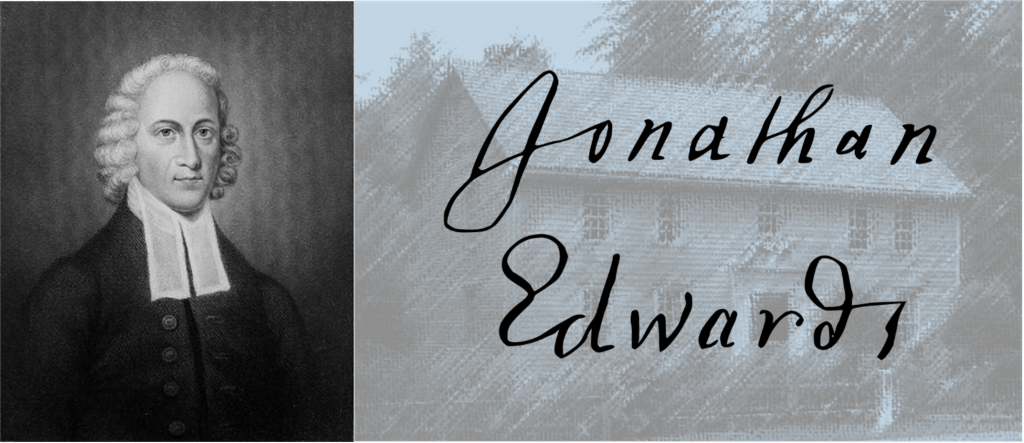
I couldn’t help but laugh. I had come upstairs for lunch, announced by my 3-year-old daughter a moment before: “Lunch is ready!” But what I found hilarious was my wife’s comment: “I don’t know if this is a Gwennie portion or a Jonathan Edwards portion.” On my plate lay a couple of fish fillets and five broccoli florets. Gwennie portions were smaller portions, which had become something of a running joke. But Jonathan Edwards portions?
The evening before I had remarked to Gwen that our dinner that night (Chinese) was a bit more forgiving than our dinner the night before (sloppy joes) in terms of post-dinner productivity. While how much I ate certainly played part, I found myself not nearly as lethargic after the Chinese. With this, I told Gwen about how, among his many resolutions, Jonathan Edwards had included one about his diet (two, actually). As I had remembered it, he was concerned that his diet didn’t impede his ability to study well. Or, positively, that it aided in his study. This I paraphrased to her.
What he actually resolved was this:
20. Resolved, to maintain the strictest temperance in eating and drinking.[1]
And:
40. Resolved, to inquire every night, before I go to bed, whether I have acted in the best way I possibly could, with respect to eating and drinking. Jan. 7, 1723.
Whence the connection to study? I must have picked this up along the way, perhaps from Marsden, who, commenting on the twentieth resolution, wrote, “On this he was constantly experimenting with himself, seeing how much he needed to eat out of necessity and avoiding all excess that would dull his mind or rouse his passions.”[2] It appears I extrapolated some. But considering his penchant for study[3] and his prolific output,[4] I don’t doubt for a moment he had diet’s effects on his productivity in view when he wrote these resolutions.
One thing I know for sure, however, is that these diet resolutions, as well as the dozens of others he made, were intended first for God’s glory:
1. Resolved, that I will do whatsoever I think to be most to God’s glory, and my own good, profit and pleasure, in the whole of my duration, without any consideration of the time, whether now, or never so many myriad’s of ages hence. Resolved to do whatever I think to be my duty and most for the good and advantage of mankind in general. Resolved to do this, whatever difficulties I meet with, how many and how great soever.
To be sure, his study and writing were (and are) arguably the foremost means by which he glorified God.
What about you?
Resolutions, goal setting, and the like are topics of perennial interest – and action. For good reason, no doubt. I won’t get into the reasons here, nor much philosophy. The literature is abundant. Generally, I think resolutions and goals are very good things. I’ve set a few myself. I’ve met with success. I’ve met with failure. I suspect you have too.
It’s the beginning of July, which marks the halfway point of the year (a year that marks the 300th anniversary of when Edwards started writing his resolutions!).[5] Did you make any resolutions at the start of the year? If so, where are you at with those? Have you kept up? On all? On some? On none? Some resolutions should surely remain constant (like glorifying God), but most should probably evolve to some degree over time, and some can happily be closed out or cast off. Principles should largely remain, but how they are carried out can change. One helpful and necessary principle is review. In the preamble to his resolutions, Edwards wrote, “Remember to read over these Resolutions once a week.” (Edwards was impressive, but I can’t help but wonder if he kept that up!) The point is sound though and should be practiced. Again, where are you at with yours? Admittedly, this is one of those things I know, but don’t do enough. This is a good reminder. Another and final good reminder comes from Edwards’s very first words:
Being sensible that I am unable to do anything without God’s help, I do humbly entreat him by his grace to enable me to keep these Resolutions, so far as they are agreeable to his will, for Christ’s sake.
When resolving, God is with whom we should begin. When reevaluating our resolutions, God is to whom we should return. When endeavoring to carry them out day by day, week by week, month by month, and year by year, God is on whom we should – on whom we must! – rely.
Additional notes:
For a list of his resolutions, enumerated but arranged by category, see The Resolutions of Jonathan Edwards.
For a more thorough introduction to Edwards and his resolutions see: The Resolutions of Jonathan Edwards by Stephen Nichols.
[1] Originally read in Jonathan Edwards, Jonathan Edwards’ Resolutions And Advice to Young Converts, ed. Stephen Nichols (Phillipsburg, NJ: P&R Publishing, 2001). Copied here from https://www.desiringgod.org/articles/the-resolutions-of-jonathan-edwards.
[2] George Marsden, Jonathan Edwards: A Life (New Haven, CT: Yale University Press, 2003), 51.
[3] Marsden, 133.
[4] See his works at Logos or Yale.
[5] See Marsden, 50.
 Toward Articulation